Dorothea's Princess Micomicona ruse
Don QuixoteDorothea’s Princess Micomicona ruse is a carefully staged appeal that uses the conventions of chivalric romance to draw Don Quixote out of the Sierra Morena and set him on the road home. Dorothea supplies the role, costume, and petition; the curate and the barber supply the plan; and Don Quixote’s own sense of knightly duty supplies the force that makes the deception work. The scene turns literary make-believe into a practical instrument, even as Sancho Panza imagines that the invented princess might bring him an empire of his own.
Origins and design
The ruse takes shape after Cardenio and Dorothea accept the curate’s offer of help. He proposes that they go to his village, find what they need, and consider how to locate Don Fernando or restore Dorothea to her parents. The barber explains the immediate problem: Don Quixote is living out his madness in the wilderness, and Sancho Panza has gone to seek him. When the curate describes the scheme to bring Don Quixote home, Dorothea offers to play the distressed damsel herself. She has read many books of chivalry and says she knows how such women petition knights-errant for assistance. Her knowledge is not merely decorative: it gives the rescue plan a form Don Quixote is prepared to recognize and obey.
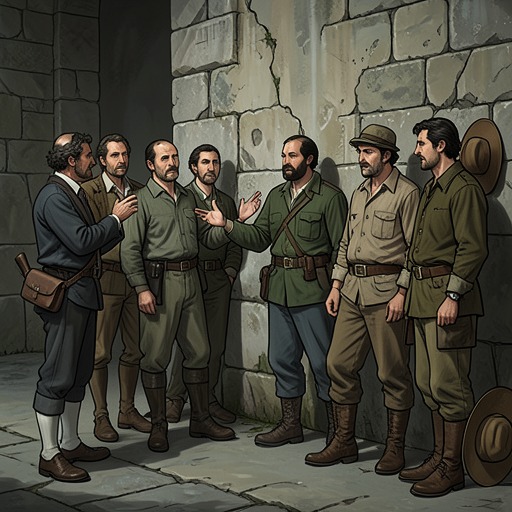
The plan depends on disguising the rescuers’ purpose as an adventure. The curate tells Sancho Panza that his master must not learn that the curate or the barber is involved, since the prospect of Don Quixote becoming an emperor depends on keeping their identities hidden. The curate and Cardenio therefore stay behind, while Dorothea and the barber go ahead with Sancho. Cardenio avoids the encounter because a reminder of his earlier quarrel with Don Quixote might disrupt the performance; the curate has no need to be present yet. The separation of the group makes the deception workable: Sancho can lead them to the knight without revealing that the supposed petitioner is part of a rescue operation.
Costume and transformation
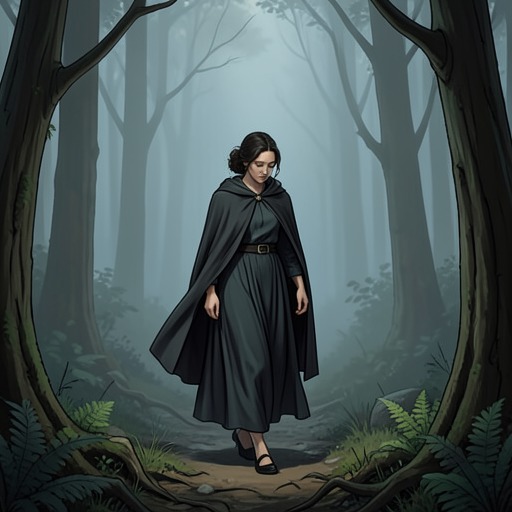
Dorothea brings the materials for the role with her. From a pillowcase she takes a rich petticoat and a fine green mantle; from a small box she produces a necklace and other ornaments. She explains that she carried these things from home in case she needed them, though she had not previously used them. In an instant, she appears to the others as a great and wealthy lady. The costume makes the fiction legible before she speaks, while her practiced command of romance conventions enables her to sustain it in the encounter.
The transformation also changes how the others respond to her. The group admires her grace, bearing, and beauty, and comments that Don Fernando showed poor judgment in rejecting her. Sancho Panza is especially impressed and eagerly asks the curate who she is and what she wants in the remote country. The curate answers by inventing her identity as the male-line heiress to the Kingdom of Micomicon, a princess who has come from Guinea to ask Don Quixote to right a wrong inflicted by a wicked giant. The explanation gives Dorothea a rank, a kingdom, and a conventional reason to seek a knight’s aid. Sancho accepts the premise readily, because it fits the hopes he has built around his master’s imagined advancement.
The encounter and petition
After travelling about three-quarters of a league, the party finds Don Quixote among the rocks. He is clothed but without his armour. When Sancho identifies him, Dorothea urges her palfrey forward, followed by the barber with an ox-tail beard fitted to his face. The barber’s disguise completes the image of a travelling princess accompanied by an attendant. He helps Dorothea dismount, and she kneels at Don Quixote’s feet. Her position and formal appeal reproduce the expected scene of a helpless petitioner seeking the protection of a famous knight.
Dorothea refuses to rise until Don Quixote grants her a boon. He first insists that she stand before he will answer or hear more. She maintains her condition, and he agrees to grant the request subject to a crucial qualification: it must not harm his king, his country, or the lady who holds his heart and freedom. The qualification shows that even inside the performance he preserves his imagined obligations to his sovereign and to Dulcinea of Toboso. Sancho Panza quietly reassures him that the request is harmless and reduces it to the prospect of killing a giant, identifying the petitioner as Princess Micomicona. Don Quixote then accepts the boon as an act required by his profession and conscience.
The quest that brings him away
Dorothea’s request is designed to bind Don Quixote to a course of action before he knows its details. She asks him to accompany her wherever she leads and to undertake no other adventure until he has avenged her on a traitor who has unlawfully usurped her kingdom. Don Quixote agrees. He promises that, with God’s help and his own arm, she will be restored to her throne, and urges immediate action because delay may bring danger. The invented grievance thus redirects the knight’s existing appetite for adventure toward a destination chosen by the rescuers.
The scene ends in a decisive physical change. Dorothea tries to kiss Don Quixote’s hands, but he prevents her and courteously raises her. He embraces her, orders Sancho Panza to check Rocinante’s girths, and calls for his armour without delay. Sancho takes it from a tree where it hangs like a trophy, attends to the girths, and arms his master. The ruse has succeeded not merely in securing a promise but in restoring Don Quixote to motion: the isolated penitent is again a travelling knight, ready to follow the supposed princess.
Romance as a practical instrument
The episode derives its comedy from the ease with which a fictional identity can organize real action. Dorothea’s role is fabricated, but its details are purposeful: noble clothing, a kingdom in peril, a usurping enemy, a kneeling petitioner, and a boon that obliges the knight to act. Don Quixote responds according to the rules he believes he serves, while the curate and the barber use those same rules to guide him home. The ruse does not persuade him to abandon his chivalric world; it succeeds by making that world point in a direction chosen by others.
Sancho Panza’s response reveals a second use for the fiction. He hopes the supposed princess will marry Don Quixote, preventing him from becoming an archbishop and helping him reach an empire in which Sancho expects a place of authority. Because Sancho is married and has a wife and children, he reasons that a church appointment would be impractical for him. His calculations turn the rescue into a prospective social promotion, even as Dorothea’s performance is intended to end Don Quixote’s wandering. The same invented princess therefore serves different hopes: she is a chivalric petitioner to Don Quixote, a marriage prospect in Sancho’s expectations, and the instrument of the curate’s plan to get his master home.